Showing posts with label Indian philosophy. Show all posts

Thursday, May 14, 2026

Monkey God in Space: Project Hanuman by Stewart Hotston


I saw Stewart Hotston's Project Hanuman on the new books shelf at my local library, and it seemed like very much my thing (space opera with elements of Indian mythology, and an author influenced by Iain M. Banks!). I immediately moved it toward the top of my to-read pile.

The science fictional and philosophical ideas are quite Banksian. Sometimes I just need some spacey SF in my life, and this hit the spot. It's not a perfect fit (more on that later), but overall I really enjoyed this! 

Wednesday, September 24, 2025

Birthday Reflections 2025: Death, Love, and Birthdays


In my birthday blog posts, I always mention that birthdays are both a good reason to celebrate life as well as a reminder of our mortality. Birthdays eventually lead to a deathday for us all. None of us are here forever. 

Since my previous birthday, this fact has become even more exigent for me. Last October I lost two friends within two days of one another. One acquaintance died a few months ago. We lost my wife's aunt as well. I lost another friend just last week. 

I miss them all deeply. I’m no stranger to grief. I’ve written a lot about losing my mom 25 years ago. That grief is with me every day and always will be. 

Still, this year I can’t help but think that the friends I lost in the last year were close to my age. And my mom was only two years older than I am now when she died. Every year, my age provides less and less insulation from the realization that none of us are here forever, and I am no exception. 

Monday, June 9, 2025

Floating in the Dream-Sea: The Great and Secret Show by Clive Barker


I first read Clive Barker's The Great and Secret Show about 30 years ago. It always stuck with me. Not so much specific plot points or even all the major characters, but certain ideas, scenes, and turns of phrase. I'm glad I decided to read this again. I loved it every bit as much, if not more, than I did the first time.

Like much of Barker's work, this might properly be called dark fantasy rather than horror, per se, although there are plenty of horror elements. 

It's also, as the introduction to this edition informs us, a result of Barker's engagements with philosophy. As an academic philosopher, I was amused by Barker's distain for "philosophical equations" encountered in university philosophy courses (a fair criticism of much of what we in the biz call analytic philosophy). Instead, Barker has been intrigued by Big Questions about belief, imagination, and mind--a point which makes a lot of sense of his work, especially when you combine it with some Lovecraftian sensibilities and Barker's own gnarly imagination.

And when it comes to The Great and Secret Show in particular, Barker tells us that Carl Jung was a major inspiration. The idea of a collective unconscious is too fertile for artists and storytellers like Barker to pass up, and I can see why, especially when Barker creates something as interesting as the concept of the dream-sea of Quiddity as his own riff on Jungian ideas.

But maybe I'm getting ahead of myself. What about the plot?

We meet a man named Jaffe who works in a dead letter office in Omaha, Nebraska in 1969. He begins reading letters about something called the Art, a secret, more real world beyond our own, and a sea of imagination and dreams called Quiddity. He embarks on a quest to control this other realm for himself (first step: murder his boss). This part of the novel goes a bit quickly, but somehow Barker makes it work as Jaffe goes from miserable postal employee to megalomaniacal murderer in a few dozen pages.

But the real story picks up a few years later in town of Palomo Grove, California. Jaffe and an antagonist of sorts called Fletcher become something more than human, and draw the town into their machinations, which result, in complicated Barker dark fantasy fashion, in the birth of several babies with both human and nonhuman fathers.

Okay, the story really picks up 18 years later with the babies now young adults. And Jaffe and Fletcher are still around, but also not exactly human.

Things get, um, complicated from there. But every twist and turn along the way is worth the journey. We meet a washed-up Hollywood comedian. A journalist and his friend named Tesla, both of whom become vital to the story later, as are some of those 18 year olds (Tesla in particular is an awesome character). There's also an ape-human hybrid, a wizard residing in a pocket dimension, and a character from other Barker stories who shows up briefly in this one and (if I remember correctly) much more in the sequel, Everville (which I also plan to re-read). And eventually there are horrors from beyond...

And yes, this is Clive Barker, so there's plenty of gnarly violence and kinky sex (and plenty of gnarly sex and kinky violence).

I don't know if I could summarize the whole plot here if I wanted to, which gets complicated and involves a lot of surprises, but my recommendation is to enjoy floating on the currents in Barker's dream-sea.

But what about Quiddity? It's a beautiful and deep idea. Definitely one I remembered for the last few decades. It's Barker's riff on Jungian ideas, with his own special touches. Particularly beautiful is the idea that all humans swim in the dream-seas of Quiddity three times in their lives: once at birth, once when they sleep next to the love of their life, and again before death. It's the source of love and life and creation for human beings (and not just human beings).

It's also dangerous, at least in the hands of those who want to control it rather than be shaped and invigorated by it. I love this way of thinking through the deep mystery of the human creative process: what are we doing when we create art and stories? How is creativity tied to love and hope and meaning? Are there worlds beyond that which we can see and hear and touch? Are those worlds more real than we know? How would we know?

Reading this again makes me wonder if Barker was one of the authors that made me think the kinds of thoughts that led me to study philosophy. I'm glad he turned away from academia and became, well, Clive Barker. But I'm also grateful that he's still enough of a philosopher to write beautiful, deep, and complicated works like The Great and Secret Show. Barker may also have explored a form of philosophical idealism somewhat similar to Kashmiri Shaivism in classical Indian philosophy (all is mind, and mind is a type of creativity).

Like Quiddity itself, however, The Great and Secret Show is vaster than I can summarize here. My advice: take the plunge for yourself.


See also my Goodreads review.

Sunday, April 6, 2025

First Contact Day, Hands Off, and the Fruitfully Inscrutable Effects of Protest


A shot of the Hands Off Protest in Chattanooga, TN, April 5, 2025.
You can see me in the street on duty as a crossing guard. (Credit: Sophia Cowan)

Yesterday, April 5, 2025, saw the the confluence of two events. For Star Trek fans, it was First Contact Day, a day that celebrates first contact between humans and Vulcans, which in most Star Trek timelines will take place on April 5, 2063 (a mere 38 years from now!). Yesterday was also a Hands-Off protest with over 1000 individual events around the US, including here in Chattanooga, Tennessee. Millions of Americans nationwide protested the recent dramatic actions of the Trump administration and his ally Elon Musk.

How on Earth (or any other planet) could these two events be connected?

Tuesday, January 7, 2025

Conference Panel: Building a Network of Scholars in Indian Philosophy: The Indian Philosophy Blog and Beyond

One of my favorite New York landmarks: The Empire State Building

Happy New Year!

After a nice, but all-too-short winter break, I'm hitting the ground running this week with a start to my spring semester as well as travel to the American Philosophical Association Eastern Division Conference in New York City! I'll be chairing a panel called "Building a Network of Scholars in Indian Philosophy: The Indian Philosophy Blog and Beyond" on Thurs. Jan. 9. I've been part of The Indian Philosophy Blog since 2015, so this will be a nice time to celebrate the blog as well as a chance to meet some fellow scholars and think about the present and future of our little sub-discipline.

Tuesday, October 15, 2024

To Absent Friends: Jerry and Anand


To absent friends...


I lost two friends last week. It has been difficult. If you might be so kind, dear reader, let me say a bit to honor these two absent friends, Jerry and Anand. 

Saturday, July 6, 2024

The Lathe of Fascism: Some Desperate Glory by Emily Tesh


At first I wasn't sure what to think about Some Desperate Glory by Emily Tesh, then I started to really love it, then I lost the thread as the central science fictional premise never really made sense to me, and then it came back together toward the end with some interesting thoughts on fascism, gender, indoctrination, and war. This one is nominated for a Hugo this year, and I will be voting for that soon. So, what did I think?

Tuesday, June 11, 2024

Your Own Personal Dittos: Kiln People by David Brin


I met David Brin (the author of Kiln People and many other novels) at a signing about a decade ago. In our small talk (awkward for me; natural for him), I mentioned that I was a philosopher and he recommended Kiln People, which I soon picked up ... and somehow didn't read until now. (If only I had some dittos to get through my to-read pile!)

The idea is really fun and philosophically interesting when it comes to the issue of personal identity (What makes you you? What is a person?). But the plot never really engaged me, and the novel falls into a common SF problem where the societal changes of time and technology are under-explored, which made it hard for me to really buy into the whole concept of dittos.

Sunday, June 9, 2024

Retellings, Buddhisms, and Other Fantasies: The Saint of Bright Doors by Vajra Chandrasekera


Vajra Chandrasekera's The Saint of Bright Doors just won the Nebula and it's part of my Hugo reading, so this seemed like a good time to finally review it (I read most of it on a trip and didn't have time to review it until now).

The Saint of Bright Doors is a difficult book to describe: South Asian inspired magical realism about doors leading to mysterious realms? A critical retelling of the life of the Buddha from the Buddha's son's point of view? A queer love story? A story of revolution? All of the above, and more?

Tuesday, April 23, 2024

Frank Herbert Beyond Dune: The Eyes of Heisenberg and The Godmakers


I still intend to write more about Dune Part Two (beyond my initial non-spoilery thoughts here). I've seen it a few times, and I've loved it more each time. I hope to see it at least once more in full-size IMAX before trying to wrangle some of my many thoughts into something resembling a comprehensible blog post. Please accept the following post for now!

It's easy to forget for those of us who love Dune and its various screen adaptations, but Frank Herbert wrote a lot of novels that are neither Dune nor its sequels. I've read a few of them over the years, including The White Plague a few months ago.

The good thing about Herbert's non-Dune work is that it's fun to explore a favorite author's other work. The bad thing about exploring Herbert's non-Dune work is that none of it is Dune. 

It's difficult advice for Dune-obsessed nerds like me to take, but every time I read non-Dune Frank Herbert, I tell myself not to expect Dune. Because it never measures up. But failing to be one of the most influential and mind-expanding science fiction series of the 20th century shouldn't stop you from reading a novel, even if it is written by the author of that series.

So, here are my reviews of two non-Dune Frank Herbert novels I've read recently: The Eyes of Heisenberg and The Godmakers!

Sunday, July 23, 2023

Postcolonial Hogwarts with Fun Etymologies: Babel by R. F. Kuang


If I had to describe R. F. Kuang's Babel, or, The Necessity of Violence: An Arcane History of the Oxford Translators' Revolution in one phrase, I'd go with "Postcolonial Hogwarts with Fun Etymologies." Depending on how you feel about Harry Potter, postcolonial theory, and etymology, that may sound dismissive, but I don't mean to be dismissive at all. I really loved almost everything about this book, especially the etymologies (although I have to point out a mistake with the Devanagari script when a Sanskrit etymology is given on p. 474). 

Monday, February 13, 2023

New Article: “Pramāṇavāda and the Crisis of Skepticism in the Modern Public Sphere” by Amy Donahue (Cross-posted from the Indian Philosophy Blog)

Depiction of a debate between Maṇḍana Miśra and Śaṅkara with judge Ubhaya Bhāratī


I haven't cross-posted anything from the Indian Philosophy Blog in a long time, so here you go! This is about a great article from my colleague Dr. Amy Donahue. There's also some information about an upcoming conference panel where she and I will be presenting with Dr. Arindam Chakrabarti. Check it out! 

PS: You can find the original post on the Indian Philosophy Blog here.


Readers of the Indian Philosophy Blog may be interested to learn about a new article in the latest issue of the Journal of World Philosophies: “Pramāṇavāda and the Crisis of Skepticism in the Modern Public Sphere” by Amy Donahue (Kennesaw State University). The journal is open-access, and you can download the article here.

Here’s the abstract:

There is widespread and warranted skepticism about the usefulness of inclusive and epistemically rigorous public debate in societies that are modeled on the Habermasian public sphere, and this skepticism challenges the democratic form of government worldwide. To address structural weaknesses of Habermasian public spheres, such as susceptibility to mass manipulation through “ready-to-think” messages and tendencies to privilege and subordinate perspectives arbitrarily, interdisciplinary scholars should attend to traditions of knowledge and public debate that are not rooted in western colonial/modern genealogies, such as the Sanskritic traditions of pramāṇavāda and vāda. Attention to vādapramāṇavāda, and other traditions like them can inspire new forms of social discussion, media, and digital humanities, which, in turn, can help to place trust in democracy on foundations that are more stable than mere (anxious) optimism.

I enjoyed reading the article, and I found it extremely thought-provoking. I hope readers of this blog will check it out. Also, be sure to look for the forthcoming online debate platform that Donahue mentions on p. 5! Maybe we’ll make an announcement on the blog when it’s ready. Or reach out to Dr. Donahue if you’re interested in collaborating.

Here are a few of my questions for further discussion:

  1. Since pramāṇavāda was an elite discourse in historical South Asian societies and it requires some educational training (as Donahue notes on p. 4 and p. 5), can it do the work Donahue asks it to do?
  2. Are jalpa and vitaṇḍā so bad? While most Naiyāyikas have denigrated them as illegitimate as Donahue notes (p. 6), a few have distinguished “tricky” and “honest” forms of vitaṇḍā (Matilal 1998, 3). And then there’s Śrī Harṣa’s debate at the beginning of the Khaṇḍanakhaṇḍakhādya with a Naiyāyika opponent about whether one must accept the means of knowledge (pramāṇas) in order to enter into a debate about the pramāṇas (he mentions that one understands the discourse of the Madhyamakas and Cārvākas, perhaps thinking of Nāgārjuna and Jayarāśi; I will have more to say about the Cārvākas in an upcoming conference presentation—see information below). Matilal has also argued that vitaṇḍā can make sense as resulting in a “commitmentless denial” similar to an “illocutionary negation” (Matilal 1998, 50-56). In terms of a modern public sphere, could vitaṇḍā be a useful tactic for, say, pointing out the inherent contradictions of various harmful dogmatisms? Or maybe the deepest benefit of the vāda-jalpa-vitaṇḍā framework is a bit of self-awareness about which form of debate one is using?
  3. Is vāda necessarily more prone to discrediting false beliefs than a Habermasian public sphere or the type of marketplace of ideas in John Stuart Mill’s On Liberty? (p. 11) My point is most definitely not that we have nothing to learn from Indian logic and debate. Far from it! But I wonder how effective vāda can be. After all, you don’t find much philosophical agreement in the classical Indian tradition, which is precisely why I find it so interesting!
  4. Is the archive (p. 12) essentially part of vāda, or is it a cultural artifact of the Indian and Tibetan tradition of commentaries? Was there something similar in Hellenistic, Roman, Islamic, and Byzantine traditions, which were also heavily commentarial?

My questions here are meant to be taken in the spirit of vāda to keep the conversation going. I hope others will read Donahue’s thought-provoking article and join this worthwhile conversation.

Also, if you will be attending the upcoming Central APA Conference in Denver, Colorado, USA on Feb. 22, 2023, you will have the chance to discuss these and other issues in person! 

Wed. Feb. 22, 2023, 1-4pm

2022 Invited Symposium: Vāda: Indian Logic and Public Debate 

Chair: Jarrod Brown (Berea College)

Speakers: 

Amy Donahue (Kennesaw State University) “Vāda Project: A Non-Centric Method for Countering Disinformation”

Arindam Chakrabarti (University of Hawai’i at Manoa) “Does the Question Arise? Questioning the Meaning of Questions and the Definability of Doubt”

Ethan Mills (University of Tennessee at Chattanooga)  “Cārvāka Skepticism about Inference: Historical and Contemporary Examples” 

(More information about the conference here, including a draft program that includes several other panels on Indian philosophy.)

Works Cited

Donahue, Amy. 2022. “Pramāṇavāda and the Crisis of Skepticism in the Public Sphere.” Journal of World Philosophies 7 (Winter 2022): 1-14.

Matilal, Bimal Krishna.  1998.  The Character of Logic in India.  Edited by Jonardon Ganeri and Heeraman Tiwari.  Albany: SUNY Press.

Friday, January 27, 2023

Upcoming Talk and Recent Indian Philosophy Blog Posts


I'm on sabbatical this semester, which means I'm spending more time on the research side of my job. Here are a few professional happenings on that front.

I have a few other things coming up in the new few months, including in-person conferences in Denver and San Francisco. The San Francisco conference will include the inaugural panel of the new Science Fiction and Philosophy Society!

I had to promise my university I would produce a book proposal for a new book project during my sabbatical (likely focusing on Vasubandhu and Ratnakīrti), so I may have details on that in a few months. Stay tuned!

Monday, January 16, 2023

MLK Day and Kindred: History is Still With Us

MLK mural at the MLK Day Parade and March, Chattanooga, TN (Jan. 16, 2023)


Today has been another Martin Luther King, Jr. Day here in the United States. In the past I've written posts including "MLK Day 2020: Labor, Love, and Community" and "So You're Going to Quote MLK?"  I thought of the former post a few weeks ago when Republican Congressman Chip Roy quoted King during one of the tragicomic votes for US House Speaker.

This year I attended the 2023 MLK Day Parade and March here in Chattanooga, Tennessee with my union, United Campus Workers. (See photo above).

Monday, December 12, 2022

The Space of Minds: Children of Ruin by Adrian Tchaikovsky


I loved Tchaikovsky's Children of Time, which is some of the most interesting science fiction I've read in recent years. I found this sequel, Children of Ruin, a bit harder to follow, but it's mainly because there's just so much going on it was easy for me to forget who's who and what was happening (maybe this one is written too much in octopus mode for my mere human intellect!). Still, I loved this book. I only rate it slightly lower in comparison to the first.

Saturday, November 19, 2022

Mini-Reviews of Spooky Stuff for Spooky Season, Part Two


Here at Examined Worlds, er, we don't say stuff like, "here at Examined Worlds." But if we did, and if there was a "we" beyond you and me, dear reader, I'd say something like, "Here at Examined Worlds, we consider spooky season to be a state of mind, not a month on the calendar."

And that's why I'm posting Part Two of my "Mini-Reviews of Spooky Stuff for Spooky Season" in the middle of November, a week before US Thanksgiving (although I may revisit some of my Thanksgiving horror favorites soon!). Enjoy!

Friday, October 28, 2022

Slashers and Human Experience: My Heart is a Chainsaw by Stephen Graham Jones


"Horror's not a symptom, it's a love affair" 

-My Heart is a Chainsaw, p. 174.


Jade, the main character of Stephen Graham Jones's My Heart is a Chainsaw, is a half-Native teenage girl in rural Idaho. She loves slasher movies so much she cites them constantly and hopes, in a weird sort of way, that some killings in her hometown are a real life slasher. I'm maybe not quite a big enough slasher fan to fully appreciate this book, but I loved Jade's extra credit papers on the history of slashers that were interspersed between the narrative chapters.

Like many horror fans, I appreciated Jade's POV as the weird kid (horror is a genre for weird kids of all ages). While Jade may or may not have some legitimate mental health issues, I also appreciated the exploration of how horror can be healthy part of fans' lives. As she tells one adult, "Horror's not a symptom, it's a love affair" (p. 174).

This gets at a big philosophical issue in horror: Why do horror fans like all this gruesome stuff? Why do we like to be scared by things we know don't exist? This novel takes it a step further: Is it still fun if it does start to happen in real life?

Another issue I've been thinking a lot about with regard to the 5th century Buddhist philosopher Vasubandhu: to what extent is our very perception of things dependent on our past and our interests? Vasubandhu goes pretty deep with this (maybe to the very existence of the external world, or at least our concept of it), but the novel can prompt a similar thought: to what extent is there really a slasher here, given Jade's interest in slasher movies that organizes her whole experience of the world? Or is she reading too much into what could be a series of random murders?

All of this kept me going, especially as I was getting to know Jade in the first 200 page or so, but I have to admit that at times in the middle of the book the plot dragged a bit for me, and I wondered if there's really quite enough story for a 400 page novel. Not that it was unpleasant to read, but I at times wanted to get things moving a little faster (maybe a couple fewer red herrings would do it?).

Still, I really enjoyed spending some time with this character, the slasher stuff is fun, and the larger mythology it sets up is worthy of further exploration. But don't worry, like any slasher worth its mask, this one is reportedly getting a sequel!


See my Goodreads review.

Thursday, October 13, 2022

Random Thoughts, Part 19: Randomize Then, There are Other Thoughts Than These


My long-running random thoughts series continues with Part 19! And since this is Part 19 and I'm a huge fan of Stephen King's Dark Tower series (where this number figures heavily, at least in the later books), I figured I would riff on my favorite line from the series (even though this quote randomly comes from the first book well before the 19 stuff took off... but that's more fittingly random, I suppose).

I haven't posted one of these since May, and the random thoughts stop for no blog, so I have even more random thoughts than usual. It looks like I got up to the totally random number of 502 with this post! How random!

And as always: plenty of memes for your random memetic enjoyment! Enjoy!

Monday, February 28, 2022

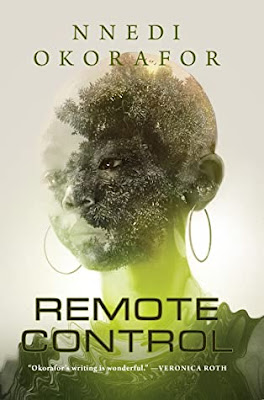
Reading for Black Future Month 2022: Remote Control by Nnedi Okorafor and Rosewater by Tade Thompson


Last year I wrote a post on "Black History of the Future" with reviews of novels by Samuel R. Delany, Walter Mosley, and Octavia E. Butler. This year for Black History Month, I decided to take an even more explicit cue from N. K. Jemisin's How Long 'Til Black Future Month in calling this post "Reading for Black Future Month 2022." I read two books set in future Ghana and Nigeria respectively: Nnedi Okorafor's Remote Control and Tade Thompson's Rosewater.  

I also started a book in Octavia E. Butler's Patternist series, Clay's Ark, but it looks like that one is going to spill over in to Women's History Month for me. Look for that review soon.

And of course nobody should limit their reading of Black and/or women authors to February and/or March! But these provide nice ways to give some structure and inspiration to my reading.

Thursday, November 4, 2021

My Appointment with Destiny (if by "destiny" you mean a tweet with several hundred likes)


On Wednesday morning this week, I had a thought that mildly amused me based on another tweet I saw, so I turned it into a tweet. See above. Or see here.

I somehow have a bunch of followers on Twitter (about 1,900), but most of my tweets are lucky to get a handful of likes. I'm actually okay with that. To be honest, I got on Twitter in 2016 unsure of why I was doing so, and I have yet to figure out what I'm doing on Twitter five years later. I don't think at the speed of Twitter, nor have I cracked the code of going viral.

Until now.