Showing posts with label Epistemology. Show all posts

Tuesday, April 23, 2024

Frank Herbert Beyond Dune: The Eyes of Heisenberg and The Godmakers


I still intend to write more about Dune Part Two (beyond my initial non-spoilery thoughts here). I've seen it a few times, and I've loved it more each time. I hope to see it at least once more in full-size IMAX before trying to wrangle some of my many thoughts into something resembling a comprehensible blog post. Please accept the following post for now!

It's easy to forget for those of us who love Dune and its various screen adaptations, but Frank Herbert wrote a lot of novels that are neither Dune nor its sequels. I've read a few of them over the years, including The White Plague a few months ago.

The good thing about Herbert's non-Dune work is that it's fun to explore a favorite author's other work. The bad thing about exploring Herbert's non-Dune work is that none of it is Dune. 

It's difficult advice for Dune-obsessed nerds like me to take, but every time I read non-Dune Frank Herbert, I tell myself not to expect Dune. Because it never measures up. But failing to be one of the most influential and mind-expanding science fiction series of the 20th century shouldn't stop you from reading a novel, even if it is written by the author of that series.

So, here are my reviews of two non-Dune Frank Herbert novels I've read recently: The Eyes of Heisenberg and The Godmakers!

Saturday, February 10, 2024

Sci-Fi Kant: The Thing Itself by Adam Roberts


The Thing Itself by Adam Roberts has been on my list for years, and a cold snap in January seemed like the best time to read it. As a philosopher and science fiction fan, I was already on board for science fiction with a Kant angle, but the obvious links to Lovecraft and John Carpenter's The Thing made it so much MY THING (itself?) that I'm shocked it took me so long to get to it. I'm sure I would have read it sooner if I realized it was so funny (not quite as outright zany as Douglas Adams or The Illuminatus Trilogy and not quite on an Iain M. Banks wavelength, either, but in some category of hilarity nearby). 

Sunday, November 19, 2023

Vacation Revelations: The Cabin at the End of the World by Paul Tremblay


I often find novels written in the present tense to be a bit gimmicky (like the author is trying too hard to make it feel immediate). I also don't always like horror that relies heavily on Christian symbolism (I can appreciate The Exorcist, but I prefer it when authors create new ideas to terrify us rather than riffing on centuries' old preexisting material). Yet somehow I really loved The Cabin at the End of the World, which probably says a lot about Tremblay's skills as an author. 

Monday, February 13, 2023

New Article: “Pramāṇavāda and the Crisis of Skepticism in the Modern Public Sphere” by Amy Donahue (Cross-posted from the Indian Philosophy Blog)

Depiction of a debate between Maṇḍana Miśra and Śaṅkara with judge Ubhaya Bhāratī


I haven't cross-posted anything from the Indian Philosophy Blog in a long time, so here you go! This is about a great article from my colleague Dr. Amy Donahue. There's also some information about an upcoming conference panel where she and I will be presenting with Dr. Arindam Chakrabarti. Check it out! 

PS: You can find the original post on the Indian Philosophy Blog here.


Readers of the Indian Philosophy Blog may be interested to learn about a new article in the latest issue of the Journal of World Philosophies: “Pramāṇavāda and the Crisis of Skepticism in the Modern Public Sphere” by Amy Donahue (Kennesaw State University). The journal is open-access, and you can download the article here.

Here’s the abstract:

There is widespread and warranted skepticism about the usefulness of inclusive and epistemically rigorous public debate in societies that are modeled on the Habermasian public sphere, and this skepticism challenges the democratic form of government worldwide. To address structural weaknesses of Habermasian public spheres, such as susceptibility to mass manipulation through “ready-to-think” messages and tendencies to privilege and subordinate perspectives arbitrarily, interdisciplinary scholars should attend to traditions of knowledge and public debate that are not rooted in western colonial/modern genealogies, such as the Sanskritic traditions of pramāṇavāda and vāda. Attention to vādapramāṇavāda, and other traditions like them can inspire new forms of social discussion, media, and digital humanities, which, in turn, can help to place trust in democracy on foundations that are more stable than mere (anxious) optimism.

I enjoyed reading the article, and I found it extremely thought-provoking. I hope readers of this blog will check it out. Also, be sure to look for the forthcoming online debate platform that Donahue mentions on p. 5! Maybe we’ll make an announcement on the blog when it’s ready. Or reach out to Dr. Donahue if you’re interested in collaborating.

Here are a few of my questions for further discussion:

  1. Since pramāṇavāda was an elite discourse in historical South Asian societies and it requires some educational training (as Donahue notes on p. 4 and p. 5), can it do the work Donahue asks it to do?
  2. Are jalpa and vitaṇḍā so bad? While most Naiyāyikas have denigrated them as illegitimate as Donahue notes (p. 6), a few have distinguished “tricky” and “honest” forms of vitaṇḍā (Matilal 1998, 3). And then there’s Śrī Harṣa’s debate at the beginning of the Khaṇḍanakhaṇḍakhādya with a Naiyāyika opponent about whether one must accept the means of knowledge (pramāṇas) in order to enter into a debate about the pramāṇas (he mentions that one understands the discourse of the Madhyamakas and Cārvākas, perhaps thinking of Nāgārjuna and Jayarāśi; I will have more to say about the Cārvākas in an upcoming conference presentation—see information below). Matilal has also argued that vitaṇḍā can make sense as resulting in a “commitmentless denial” similar to an “illocutionary negation” (Matilal 1998, 50-56). In terms of a modern public sphere, could vitaṇḍā be a useful tactic for, say, pointing out the inherent contradictions of various harmful dogmatisms? Or maybe the deepest benefit of the vāda-jalpa-vitaṇḍā framework is a bit of self-awareness about which form of debate one is using?
  3. Is vāda necessarily more prone to discrediting false beliefs than a Habermasian public sphere or the type of marketplace of ideas in John Stuart Mill’s On Liberty? (p. 11) My point is most definitely not that we have nothing to learn from Indian logic and debate. Far from it! But I wonder how effective vāda can be. After all, you don’t find much philosophical agreement in the classical Indian tradition, which is precisely why I find it so interesting!
  4. Is the archive (p. 12) essentially part of vāda, or is it a cultural artifact of the Indian and Tibetan tradition of commentaries? Was there something similar in Hellenistic, Roman, Islamic, and Byzantine traditions, which were also heavily commentarial?

My questions here are meant to be taken in the spirit of vāda to keep the conversation going. I hope others will read Donahue’s thought-provoking article and join this worthwhile conversation.

Also, if you will be attending the upcoming Central APA Conference in Denver, Colorado, USA on Feb. 22, 2023, you will have the chance to discuss these and other issues in person! 

Wed. Feb. 22, 2023, 1-4pm

2022 Invited Symposium: Vāda: Indian Logic and Public Debate 

Chair: Jarrod Brown (Berea College)

Speakers: 

Amy Donahue (Kennesaw State University) “Vāda Project: A Non-Centric Method for Countering Disinformation”

Arindam Chakrabarti (University of Hawai’i at Manoa) “Does the Question Arise? Questioning the Meaning of Questions and the Definability of Doubt”

Ethan Mills (University of Tennessee at Chattanooga)  “Cārvāka Skepticism about Inference: Historical and Contemporary Examples” 

(More information about the conference here, including a draft program that includes several other panels on Indian philosophy.)

Works Cited

Donahue, Amy. 2022. “Pramāṇavāda and the Crisis of Skepticism in the Public Sphere.” Journal of World Philosophies 7 (Winter 2022): 1-14.

Matilal, Bimal Krishna.  1998.  The Character of Logic in India.  Edited by Jonardon Ganeri and Heeraman Tiwari.  Albany: SUNY Press.

Friday, October 28, 2022

Slashers and Human Experience: My Heart is a Chainsaw by Stephen Graham Jones


"Horror's not a symptom, it's a love affair" 

-My Heart is a Chainsaw, p. 174.


Jade, the main character of Stephen Graham Jones's My Heart is a Chainsaw, is a half-Native teenage girl in rural Idaho. She loves slasher movies so much she cites them constantly and hopes, in a weird sort of way, that some killings in her hometown are a real life slasher. I'm maybe not quite a big enough slasher fan to fully appreciate this book, but I loved Jade's extra credit papers on the history of slashers that were interspersed between the narrative chapters.

Like many horror fans, I appreciated Jade's POV as the weird kid (horror is a genre for weird kids of all ages). While Jade may or may not have some legitimate mental health issues, I also appreciated the exploration of how horror can be healthy part of fans' lives. As she tells one adult, "Horror's not a symptom, it's a love affair" (p. 174).

This gets at a big philosophical issue in horror: Why do horror fans like all this gruesome stuff? Why do we like to be scared by things we know don't exist? This novel takes it a step further: Is it still fun if it does start to happen in real life?

Another issue I've been thinking a lot about with regard to the 5th century Buddhist philosopher Vasubandhu: to what extent is our very perception of things dependent on our past and our interests? Vasubandhu goes pretty deep with this (maybe to the very existence of the external world, or at least our concept of it), but the novel can prompt a similar thought: to what extent is there really a slasher here, given Jade's interest in slasher movies that organizes her whole experience of the world? Or is she reading too much into what could be a series of random murders?

All of this kept me going, especially as I was getting to know Jade in the first 200 page or so, but I have to admit that at times in the middle of the book the plot dragged a bit for me, and I wondered if there's really quite enough story for a 400 page novel. Not that it was unpleasant to read, but I at times wanted to get things moving a little faster (maybe a couple fewer red herrings would do it?).

Still, I really enjoyed spending some time with this character, the slasher stuff is fun, and the larger mythology it sets up is worthy of further exploration. But don't worry, like any slasher worth its mask, this one is reportedly getting a sequel!


See my Goodreads review.

Wednesday, June 1, 2022

Two Short Kings: The Colorado Kid and Cycle of the Werewolf by Stephen King


In my perhaps ill-advised and loosely-resolved quest to read all of Stephen King's books, I have come to two shorter ones published over 20 years apart (2005 and 1983). I figured I would review them together on the blog. So here are The Colorado Kid and Cycle of the Werewolf!


The Colorado Kid

I don't know how Stephen King does it, but he took a story of two folksy small town newspaper reporters telling a 25-year-old story to a 22-year-old reporter and turned it into a probing thought experiment on two kinds of stories: those that recount events loose threads and all and stories that wrap things up with a nice beginning, middle, and end. If you think about it, the first kind of story is what really happens in life. And if you think about it some more, you'll see that the "complete" stories where everything is wrapped up are entirely artificial: they always leave some things out or take liberties for the sake of narrative unity. 

In The Colorado Kid, our folksy reporters call these news stories versus features stories. I'm also thinking about a distinction used by Noam Chomsky between mysteries and problems. A problem has a solution, or at least a resolution. But a mystery may not. It may go far beyond our cognitive capacity as human beings to understand. It may remain open-ended. Like life itself. 

A lot of the so-called "mystery" genre really consists of stories of problems in this sense, or features stories to use the terminology of this book. And if I'm being honest, this is probably why I usually don't care for the mystery genre (and why I have only recently delved into King's forays into more mystery-tinted fiction, but I should have known that King's mysteries would still be, well, Stephen King). 

While I understand the appeal of wrapping up a mystery or solving a problem with a nice little bow (maybe precisely because we are usually denied such things in real life), my experience in my decades of existence has taught me that reality is rarely like that. It's simply not true to my basic sense of this universe. Our universe is full of mysteries that we may never solve. This could in some cases be horrifying or disappointing (and King explores those Lovecraftian depths elsewhere), but I prefer the answer that King hints at in this novel and seems to confirm in his Afterword: it is precisely these unresolved mysteries, these loose threads of reality, that make our lives more interesting, perhaps even more meaningful.

See also my Goodreads review.


Cycle of the Werewolf


This is a fun little story (maybe a novella, maybe really just a long-ish short story) that was originally based on an idea for a calendar (no, really). It's vintage 80's Stephen King: mysterious murders are taking place in the small Maine down of Tarker's Mills (no relation). And of course the murders take place when there is a full moon each month for a year (so this is a kind of calendar, after all!). 

And you get all of this with cool artwork from Berni Wrightson. Honestly the artwork is probably what sells this for me. The werewolf story is solid enough, but nothing all that great within King's larger oeuvre. The movie Silver Bullet is a bonkers expansion of the story in the tradition of the best schlocky 80's Stephen King adaptations.

Like other monsters, werewolves are, from the outside, a reminder of our mortality. Be they werewolves, vampires, Frankenstein monsters, mummies, creatures from the Black Lagoon, etc., monsters are there waiting for us all. You don't know when. But they will get you eventually. In particular, werewolves are a reminder of the duality within us all and a reminder that the more brutal, base side of our nature can sometimes come out unexpectedly. 

I hesitate to say "animalistic," because I like animals just fine and think they get a bad wrap. As a werewolf in wolf form, you're just trying to eat, which is little comfort to the victims, I suppose, and a horror all its own. 

Still, the real evil in this story is the conscious decision made by the human side of the werewolf character. I won't spoil it, but that, I think, is a common theme for King: the real evil isn't the monsters, it's the people. And what they do with their inner turmoil. That's a far more terrifying idea, ultimately much harder to escape, which is probably the key to King's enduring popularity. (Along with the schlocky adaptations, of course!)


See also my Goodreads review.

Saturday, April 23, 2022

Looking for What you Find: The Consuming Fire by John Scalzi


I read the first book in John Scalzi's Interdependency Series (The Collapsing Empire) several years ago and probably would have gotten more out of the first 100 pages or so of this second book (The Consuming Fire) if I had reminded myself what happened there before diving in (I had a general idea of the Flow and the Emperox, but I had forgotten the who's who of the various political intrigues, a lot of which I admit I have trouble following or caring much about).

Honestly the book didn't get super interesting to me until about halfway through, but then some really cool stuff started to happen (more on that in spoilery section).

I also have to say I think that while Scalzi's acerbic wit is still there, the patented Scalzi snark is toned down a bit in this volume, and the book is honestly better for it. You still get a few little smirks now and then, but honestly Scalzi's dialogue can sometimes be a bit extra and get in the way of the story (as if everyone is speaking in carefully-crafted tweets at all times). I appreciated the milder version of all that.

Okay, I have to get into some mild spoilers here. So be warned. 

Monday, March 28, 2022

Shifting Realities: Four Past Midnight by Stephen King


In my long-term quest to read all of Stephen King's books (a quest that feels about as attainable as Roland's Tower), I finally arrived at this classic. Four Past Midnight isn't up there with The Stand or Different Seasons, but it's solid middle-tier King, which is still good stuff. These are technically novellas, but I think The Langoliers and The Library Policeman might really be short novels for King (what would be average length novels for other writers).

Monday, February 28, 2022

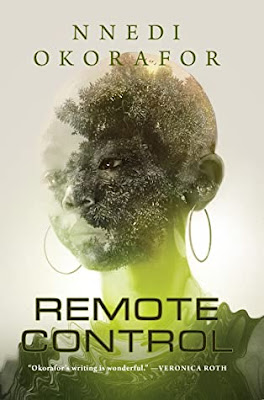
Reading for Black Future Month 2022: Remote Control by Nnedi Okorafor and Rosewater by Tade Thompson


Last year I wrote a post on "Black History of the Future" with reviews of novels by Samuel R. Delany, Walter Mosley, and Octavia E. Butler. This year for Black History Month, I decided to take an even more explicit cue from N. K. Jemisin's How Long 'Til Black Future Month in calling this post "Reading for Black Future Month 2022." I read two books set in future Ghana and Nigeria respectively: Nnedi Okorafor's Remote Control and Tade Thompson's Rosewater.  

I also started a book in Octavia E. Butler's Patternist series, Clay's Ark, but it looks like that one is going to spill over in to Women's History Month for me. Look for that review soon.

And of course nobody should limit their reading of Black and/or women authors to February and/or March! But these provide nice ways to give some structure and inspiration to my reading.

Wednesday, December 22, 2021

Initial Non-Spoilery Thoughts about The Matrix Resurrections


I just finished watching The Matrix Resurrections, one my most anticipated movies of the year (after Dune, of course). The best spoiler-free review is the shortest: Whoa.

Me, watching The Matrix Resurrections

Sunday, December 5, 2021

Pandemic Journal, Part 23: Yet Another Pandemic Semester, Also: Dune


My increasingly exhausting pandemic journal continues with Part 23 (see the most recent entry here). We had a really bad surge in the late summer and early fall with record hospitalizations and I've had yet another exhausting pandemic semester, all while many people seem to be pretending the pandemic is over. And now things are getting better, but we have the omicron variant and the winter holidays... so it's not looking great. 

But on the other hand, Villeneuve's Dune was finally released in October, ushering in a new era of Dune memes for your enjoyment. Thus, this entry will consist, not quite entirely, but mostly of Dune memes. Thanks to the dedicated members of the Dune Sietchposting Facebook group for most of these, and to various friends and other online denizens for the rest.


Saturday, September 25, 2021

Birthday Thoughts from a 45 Degree Angle


One of my low-key birthday activities today


Today is my birthday, and as has become tradition on this blog, it's time for a birthday post.

At 45, it occurs to me that I'm halfway to 90, an age I am statistically speaking unlikely to see. But that's okay. It's not like I can stop time or alter the fabric of basic arithmetic. Besides, I discovered several years ago that I had already reached middle age based on statistical life expectancy. So it's downhill from here. But again, that's okay. Downhill is the easier part.

Life isn't easier in terms of medical issues (as I have already begun to experience), but perhaps easier in terms of wisdom, at least if you count as wisdom the Socratic quip that true wisdom consists in knowing what you don't know.

Friday, June 25, 2021

Motley Crew of Little Kings: Nightmares and Dreamscapes by Stephen King


I recently started calling Stephen King short stories "little Kings." 1993's Nightmares and Dreamscapes is another great collection of little Kings. It's an interesting (and long: almost 900 pages!) collection with shades of both King's earlier and later career. I can't do justice to every story in this humble review (did I mention it's long?), but I will say there were some nice gems here and the one I was most looking forward to, "Crouch End," did not disappoint.

Tuesday, March 30, 2021

Women's History Month Review Round Up 2021: Brackett, Alexander, Moreno-Garcia, and Le Guin


March is Women's History Month, and like I did in 2019, I decided to celebrate by reading and reviewing works written by women this month. I'm reviewing the 1974 science fantasy novel Ginger Star by Leigh Brackett, the 2010 modern classic on mass incarceration The New Jim Crow: Mass Incarceration in the Age of Colorblindness by Michelle Alexander, the 2020 creepy haunted house tale Mexican Gothic by Silvia Moreno-Garcia, and--bookending the post with 70's SF--the 1975 strange little novella The New Atlantis by Ursula K. Le Guin.

I may try to keep up with my themed month reviews that I started in February for Black History Month. So stay tuned in May for Asian Pacific American Heritage Month!

Sunday, March 7, 2021

Random Thoughts, Part 13: Our Random 2021


Made at: https://www.jasondavies.com/wordcloud/


My previous entry in my Random Thoughts series was in November 2020, so with this post my Random Thoughts series rolls into 2021! There are still plenty of random thoughts to be had in this new and strange year. I've got stuff on philosophy (of course), but also recipes, medical stuff, Taco Bell, conspiracy theories, and Coming to America.

And as I started doing in 2020, I'll include some recent memes that amused me just to keep things more random.

Wednesday, December 30, 2020

The Epistemology of Evil Twins: The Dark Half by Stephen King


Only Stephen King could write a book with the somewhat silly premise of an author's pseudonym coming to life .... and make me believe it so engrossingly. 1989's The Dark Half isn't one of King's "A List" novels (it's not up there with The Stand, IT, or The Shining), but I think it's underrated.

This is also one of King's most epistemological novels (along with The Dead Zone), so let's call it... the epistemology of evil twins! (Epistemology, or theory of knowledge, is the part of philosophy that studies knowledge: what it is, how you get it, whether you have as much of it as you think, etc.).

Saturday, October 10, 2020

Pandemic Journal, Part 14: Politics, Pandemic, and For the Love of All That You Hold Dear, Vote!


My pandemic journal continues with Part 14! It has been about six months since this all started, or in pandemic time, roughly 25 years. 

As usual, I have spent the last month scouring the internet for the finest memes. You can also read about what I've been doing and thinking. But it's also okay to just browse the memes. Do what you gotta do. It's a pandemic. 

And for the love of all that you hold dear, vote if you are eligible, my fellow Americans! Jesus fucking Christ, just vote. I don't even know what to say to convince you, but if this serves as a reminder, so be it. Just vote.