Showing posts with label Science. Show all posts

Saturday, February 10, 2024

Sci-Fi Kant: The Thing Itself by Adam Roberts


The Thing Itself by Adam Roberts has been on my list for years, and a cold snap in January seemed like the best time to read it. As a philosopher and science fiction fan, I was already on board for science fiction with a Kant angle, but the obvious links to Lovecraft and John Carpenter's The Thing made it so much MY THING (itself?) that I'm shocked it took me so long to get to it. I'm sure I would have read it sooner if I realized it was so funny (not quite as outright zany as Douglas Adams or The Illuminatus Trilogy and not quite on an Iain M. Banks wavelength, either, but in some category of hilarity nearby). 

Sunday, August 20, 2023

Fun with Kaiju: The Kaiju Preservation Society by John Scalzi


My Hugo reading has begun! Maybe it's because school starts this week and I told myself I'd get a post out there before that, but this review is sadly (some may say "blessedly") short. Enjoy!

Friday, June 16, 2023

Review of Reviews: June 2023 (The Regulators, Schrödinger's City, and The Eye in the Pyramid)


It's time for another review of reviews! I'm still eagerly awaiting the announcement of this year's Hugo finalists so I can start this year's Hugo reading (although I'm taking a gamble by starting R. F. Kuang's Nebula-winning Babel, which is fantastic even if we improbably live in a universe where it won't be a Hugo finalist). While I'm waiting, I'm reading other books that are on my ever-increasing to-read list: The Regulators by Richard Bachman (aka, Stephen King), Schrödinger's City by Matthew Buscemi, and The Eye in the Pyramid by Robert Shea and Robert Anton Wilson. I guess the through-line here is that all three of these novels are pretty weird--and delightfully so. Just to mix it up, let's start with the one I finished last: The Eye in the Pyramid!

Monday, February 20, 2023

Review of Reviews: February 2023


Although I still occasionally write a longer review, most of my book reviews have been shorter as of late. I'm not sure why. Maybe I'm just appreciating brevity these days, so on that note, on to the reviews of books I've read in the last month or so!

Saturday, July 2, 2022

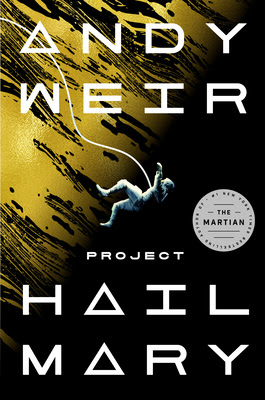
Xenobiology for Engineers: Project Hail Mary by Andy Weir


I seem to be one of the few people who liked Andy Weir's Project Hail Mary more than The Martian. It's mildly spoilery to say that the xenobiological aspects are what I enjoyed the most. At other times I felt like I was reading someone showing their work on their physics homework, but if you've read The Martian you know what you're in for. To mildly plagiarize a review I saw elsewhere: if you liked The Martian, you will probably also like Project Hail Mary.

Friday, January 7, 2022

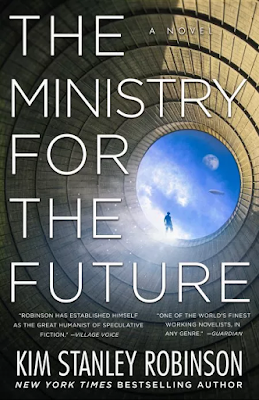
Melancholy Utopianism: The Ministry of the Future by Kim Stanley Robinson


The Ministry of the Future is up there with Kim Stanley Robinson's best work. Given how much I love his work, this counts as high praise from me.

If you're familiar with Kim Stanley Robinson (KSR), you'll have some idea of what to expect. A lot of wonky, nerdy details delivered in what his critics would call "info dumps," a lot of cool Big Ideas, a delightful thrashing of the "show don't tell" rule that's sure to give nightmares many creative writing teachers, and oh yeah, some characters and plot and stuff, too. (Indeed, I sometimes wonder if a writer like KSR would get published today given how he cuts against the grain.)

Sunday, December 5, 2021

Lunar Sleuthing: The Relentless Moon by Mary Robinette Kowal


I enjoyed Mary Robinette Kowal's third entry in the Lady Astronaut series (The Relentless Moonmore than the second volume (The Fated Sky), but not as much as the first one (The Calculating Stars). The biggest problem is that it's probably a lot longer than it needs to be, although maybe for what Kowal is going for, it's just as long as it needs to be.

Monday, September 6, 2021

Random Thoughts, Part 15: Randomly, the Pandemic Continues


Made at: https://www.jasondavies.com/wordcloud/

My Random Thoughts series continues with Part 15! My last post, Part 14, was on May 31 when I hoped that we were reaching the late stages of the pandemic ... well, that turned out not to be the case. I'm not sure if this is random as the title of this post supposes (see random thought 352 for more), but I thought it was a good title. Also, I have continued to include some random memes for your amusement.

Sunday, August 29, 2021

Nondualism and the Pandemic, Part 2

A representation of Indra's Net

Continued from Part 1...


Dualism and Responsibility 

How did the US come to possess such a set of flaws that uniquely predisposed us to react to the pandemic as we have? There are large cultural and political forces that no one of us is uniquely responsible for, but each of us bears some responsibility for. I don’t deign to know your life, dear reader, so let me think through my own example.


Saturday, September 5, 2020

Random Thoughts, Part 11: Pandemic, Politics, Philosophy, and Other Random Things

Made at: https://www.jasondavies.com/wordcloud/

My random thoughts continue! In Part 10, I got up to #221, so I'm picking up with 222 here in Part 11. Even though these are random, a lot of them focus on the pandemic, politics, and philosophy, but that's how randomness works... or is it? Anyway, there's also one about mustard, so maybe it really is random. Enjoy!


Thursday, April 30, 2020

Love, Philosophy, and Cosmic Melancholy: The Songs of Distant Earth by Arthur C. Clarke


The Songs of Distant Earth is not my favorite Arthur C. Clarke book, but it has its moments. Since he's my favorite of the Big Three 20th century SF writers (Clarke, Asimov, and Heinlein), I've been meaning to check it out. What spurred me to do so now is that I just finished Adrian Tchaikovsky's Arthur C. Clarke-Award-Winning Children of Time, which is a much newer and different book, but one with some Clarke-style Big Ideas (multiple waves of far future space exploration, hibernation, animal intelligence, etc.). In fact, I wouldn't be surprised if Tchaikovsky was influenced by this book.


Sunday, February 16, 2020

Saturday, July 20, 2019

50 Years After the Moon Landing: Where Are We Now?


Today is the 50thanniversary of Neil Armstrong and Buzz Aldrin becoming the first humans to walk on the moon with Michael Collins staying in orbit. (Since I first read about the Apollo 11 mission as a kid, I’ve always felt bad for Collins who went all the way to the moon without going for a walk!)
  
Usually statements like “one of the most amazing achievements in human history” are hyperbole, but in this case it’s completely true. The moon landing is well worth celebrating today. Have a party, raise a quiet toast to humanity, read NASA’s account here, or take a moment to glance at the moon and think, “God damn, humans went there!”
  
While celebration is a big part of this anniversary, for me it prompts the question: where are we 50 years later both when it comes to space exploration and our general condition here on Earth?
  
Space exploration, to put it mildly, has not gone the way many science fiction fans (including myself) have hoped.  Sure, we have the International Space Station and robotic missions to Mars and the rest of the solar system.  Voyager 1 and 2 are now in interstellar space. But no humans have been to the moon since 1972, and there have been no human missions elsewhere.  For people who read the great mid-20th century science fiction authors like Arthur C. Clarke, Isaac Asimov, and Robert Heinlein, this seems like a huge disappointment.  We were supposed to be living on the moon and Mars by now. Instead we got Twitter and Apple watches.
  
But is space exploration all that great a thing, anyway?  Sending humans into space is extremely expensive and dangerous, as my first major space memory, the Challenger disaster, demonstrates.  Would we be better off turning our attention to Earthly matters?  Why go to space when huge issues like poverty and climate change demand our attention here on Earth?  I’m not sure.
  
I admit that a lot of my love of space exploration stems from a romantic feeling, which is in turn spurred by my love of science fiction.  But it’s that very love of science fiction that tells me that venturing into space just might tell us a lot both about the universe and about ourselves (see Kim Stanley Robinson’s Mars trilogy or Ursula Le Guin’s Hainish novels for a bit on both fronts).  And as Octavia Butler suggested in her Earthseed duology, maybe we need a big goal like space exploration to keep us focused on something better than historical human preoccupations like killing and exploiting each other.
  
And for that matter, how are things here on Earth 50 years later?  The late 1960’s was a tumultuous era on Earth, times which it seems like we are re-entering today.  For sake of simplicity and familiarity, I’ll limit myself to the USA, but much could be said in many other places throughout the world (India, Brazil, Europe, etc.).
  
Who would have thought that 51 years after the assassination of Martin Luther King, Jr. we would have actual Nazis marching in the streets of America, emboldened by a sitting President who regularly says racist things and enforces cruel, racist immigration policies?  Who could have predicted 46 years after Roe v. Wade that many states would be instituting some of the harshest restrictions on abortion to date, or that 50 years after Stonewall it would still be legal to fire someone for being LGBTQ in over half the country?  Or that 55 years after Lyndon Johnson declared a War on Poverty, we would possibly be returning to 1920’s levels of economic inequality?
  
Given the resurgence, or at least increased visibility, of morally regressive tendencies in the last few years, how far have we really come in the last 50 years?  Interestingly, Octavia Butler maybe could have predicted this, given her depiction of a Presidential candidate who wanted to “make America great again.”
  
I don’t need to continue spelling things out.  The last few years have been a huge disappointment, at least for progressive types, many of whom, like me, have in retrospect been a bit naïve.
  
Yet, here’s a consideration: The fact that so many people are so disgusted is itself a good sign.  If everybody was on board with the recent surge in bigotry and injustice, nobody would be noticing or speaking out or complaining about it.  This feeling of despondency itself contains the seed of something better, a measure of where we might go, to hitherto unexplored territories of justice.
  
And maybe, just maybe, this spirit of pushing boundaries, of – dare I say it? – going where no one has gone before, is where something like space exploration and true justice for all coincide.  We’ve never had a reasonably just society and we’ve never adequately explored our extraterrestrial neighborhood.  We’ve had brief glimpses of both so far in science, science fiction, and social movements. 

So, maybe the moon landing of July 20, 1969 can represent our glimpses of new and better things for humanity. It is with this hope that I celebrate today.

Tuesday, June 11, 2019

Review of Reviews (The Courtier and the Heretic, Exultant, The Slow Professor, Cosmonaut Keep, Frankenstein: How a Monster Became an Icon)


It's been awhile since I posted an old-fashioned review of reviews (as opposed to a "round up"), so here it goes!  In this one I'm reviewing three non-fiction books and two fiction books: The Courtier and the Heretic: Leibniz, Spinoza & the Fate of God in the Modern World by Matthew Stewart, Exultant by Stephen Baxter, The Slow Professor by Maggie Berg and Barbara Seeber, Cosmonaut Keep by Ken MacLeod, and Frankenstein: How a Monster Became an Icon, edited by Sydney Perkowitz and Eddie von Mueller.

And if none of those pique your interest, I will be posting an all-Stephen King review of reviews soon!

Sunday, May 19, 2019

Random Thoughts, Part 4

Made at: https://www.jasondavies.com/wordcloud/

A while back I started collecting my random thoughts and putting them on my blog. There have been three parts so far (see here, here, and here). And you are now reading Part 4! Enjoy!

Friday, March 22, 2019

Book Blogs Back!: Responses to Malcolm Keating – Chapters 6-7 (Śrī Harṣa) and Conclusion

My book with a Starfleet Academy mug: both seeking the final frontier?


This is continuation of my responses to Malcolm Keating's excellent blog posts on my book, Three Pillars of Skepticism in Classical India: Nāgārjuna, Jayarāśi, and Śrī Harṣa, which Malcolm wrote in preparation for an event on March 7, 2019.  You can see my previous responses here and here.

In the present post I'm responding to two of Malcolm's posts, which you can find here and here.  As will become clear, this post isn't going to make much sense without reading Malcolm's posts first.

So, here we go!

Tuesday, October 16, 2018

Are College Students Relativists?


Several weeks ago I came up with the following hypothesis.

Hypothesis: College students aren't actually relativists in a normative philosophical sense as many philosophy teachers love to complain about, but rather students look at philosophical questions through a sort of descriptive "pop social science" lens. That is, they don't understand the distinction between the question "What is the truth?" and the question "What do people say is the truth?" Very little in our broader culture or education system prepares them to answer the Socratic question, "What should I personally think is the truth?" beyond unargued personal preference.
Corollary 1: Go easy on your students, philosophy teachers. We are asking them to do something our entire culture (and maybe even human nature) either militates against or deems literally unthinkable.
Corollary 2: This maybe also explains a lot about why philosophy and the humanities more generally are so misunderstood, disrespected, and ignored by the larger culture.

Friday, September 21, 2018

Monsters, Death, and Authenticity: Frankenstein by Mary Shelley


Like most classic novels, there are depths to Mary Shelley's Frankenstein and its ideas that a humble review like this can't hope to plumb.  From its complicated framing structure to its deep themes about human nature, science, and religion, it's no wonder this book continues to fascinate readers 200 years after its initial publication.

Sunday, August 12, 2018

Philoso-monks Save Some Worlds: Anathem by Neal Stephenson


I finally found the Neal Stephenson book that's right for me. I've enjoyed a few of Stephenson's other books (particularly Snow Crash and Seveneves), but I admit I wasn't sure what all the hype surrounding Stephenson was about. Now that I found the right book, I get it.

Wednesday, May 23, 2018

Review Bonanza, Part Three: The Frankenstein Chronicles, Three Virgins, Are Prisons Obsolete?, and More!

The Frankenstein Chronicles
Welcome to Part Three of my Review Bonanza!  See also Part One, which covered Annihilation, The Laplace's Demon, River of Teeth, and Moreand Part Two, which covered The Expanse, The X-Files, Infomocracy, Navigators of Dune, and More.

Here in Part Three, I've got The Frankenstein Chronicles, Three Virgins and Other Stories by Manjula Padmanabhan, Are Prisons Obsolete? by Angela Y. Davis, The Aztecs: A Very Short Introduction by David Carrasco, and What Kind of Creatures are We? by Noam Chomsky.